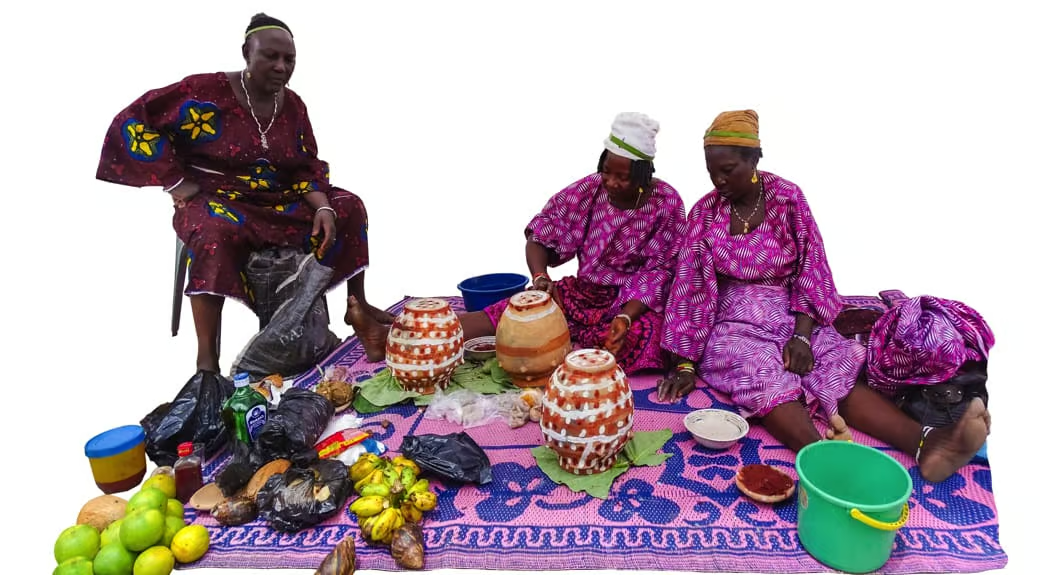
The story Yemọja is told to is older than the festival that tells it. In the West African telling, Yemọja is the deity of the Ògùn river — *Yèyé Omọ Ẹja*, “mother whose children are the fish” — born of the marriage of the earth and the sea, mother in the cosmogony to a substantial portion of the Òrìṣà pantheon. She is, in the West African tradition, a river deity. Her domain is the moving fresh water that gives life to the towns built along its banks.
When the tradition crossed the Atlantic, the geography moved with it. In Cuba, in Brazil, in the wider Caribbean, Yemọja’s body of water became the sea. The bay outside the temple in Salvador, the harbour at Regla outside Havana, the long beach south of Lagos that faces the Bight of Benin — all of these became Yemọja’s. The deity who in West Africa lives in the sweet water became, in the Americas, the deity who lives in the salt.
This is the central interpretive fact of any modern Yemọja festival. The deity is the same deity. The water is differently constituted on the two sides of the Atlantic. The festival, accordingly, is celebrated differently — and the celebrations are increasingly in conversation with each other.
## The Brazilian Festival
The most spectacular contemporary Yemọja festival is in Salvador, Bahia, on the second of February each year — the *Festa de Iemanjá* at the Praia do Rio Vermelho. Hundreds of thousands of celebrants gather over the course of the day; the procession of *iyalorixás* and *babalorixás* with the flowers and offerings for Iemanjá moves from the *Casa de Iemanjá* (the small house of the deity at the beach) to the boats that will carry the offerings out to sea.
The offerings — flowers, perfume, mirrors, combs, white cloth, sometimes letters — are loaded into wooden baskets and rowed out beyond the breakers. Whether Iemanjá accepts the offerings is read by what she returns: offerings that float back to the beach are rejected; offerings that sink to the floor of the bay are accepted. The basket count of accepted offerings is taken seriously by the senior priestesses; a year of widespread rejection is interpreted as a warning that requires collective response.
In Rio de Janeiro, the equivalent festival is held on the night of the thirty-first of December, when the same procession to the sea is made by Cariocas of all faiths — most of whom are not Candomblé practitioners but who participate in the offering as a folk tradition.
## The Cuban Festival
The Cuban festival of Yemayá is held on September the seventh — the feast day, in the Catholic calendar, of Our Lady of Regla, who has historically been the syncretic identification of Yemayá in Cuban Lukumí. The procession is from the *Iglesia de Nuestra Señora de Regla* across the bay from Havana to the harbour, where the offerings are carried out by boat.
The Cuban festival has a different character from the Brazilian — quieter, more strictly liturgical, more intimately tied to the network of senior houses that organise it. The drumming, however, is unmistakable: the *bata* drum patterns for Yemayá are among the most distinctive in the Lukumí ritual repertoire, and the *toques* for the deity will be recognised by any West African who has heard the equivalent rhythms for the river goddess at the Ògùn shrines in Abẹ́òkúta.
## The West African Festival
In Yorùbáland itself, the major festival of Yemọja takes place along the Ògùn river, with the principal celebrations at Abẹ́òkúta in Ògùn State. The festival’s exact date varies year to year and is set by the senior priestesses of the Yemọja shrine in Abẹ́òkúta in consultation with the Babaláwo of the city; the celebrations are usually in the first week of August and run for several days.
The West African festival is, of the three, the most explicitly devotional and the least public. The procession to the river is made by the priestesses (the *aworo* of Yemọja) and the senior devotees; the wider population participates in the parallel celebrations in the town but does not enter the shrine area. The offerings are placed in the river itself rather than carried out by boat.
What is striking, when one attends the West African festival after attending the Brazilian or Cuban version, is the silence. The drumming is restrained; the public spectacle is minimal; the focus is on the long ritual sequence inside the shrine, much of which is closed to outside observation. This is not a deficiency of celebration. It is a different conception of what the festival is for.
## The Three Festivals in Conversation
The three festivals are increasingly in dialogue. Senior priestesses from Bahia have travelled to Abẹ́òkúta several times in the last decade; West African priestesses have travelled to Brazil and Cuba; the offerings carried in the Salvador festival now sometimes include flowers that have been blessed at the shrine in Abẹ́òkúta the previous month.
The point of these exchanges is not to produce a single unified festival. It is to allow the three to inform each other — the Brazilian celebration to recover something of the West African ritual depth that was lost to the conditions of slavery, the West African celebration to absorb something of the Brazilian public confidence that grew under those same conditions, the Cuban celebration to mediate between them.
For the practitioner, the implication is straightforward. If you can attend any one of the three festivals in your lifetime, you should. The deity is one deity. The waters meet.
## A Note on Practical Attendance
For the Brazilian festival in Salvador, arrive in the city by the thirty-first of January; book accommodation in Rio Vermelho or central Salvador; expect the beachfront to be impassable on the day of the festival itself and plan your movements accordingly. The procession begins at first light.
For the Cuban festival at Regla, the ferry from Havana old town runs continuously on the day; the church and the surrounding plaza are the focus; the seaside offerings are made through the late afternoon and evening.
For the West African festival at Abẹ́òkúta, contact the Òrìṣà Spiritual Assembly office in Lagos at least two months in advance for guidance on attendance; respectful access to the shrine area requires introduction by a recognised priestess and is not a matter of simply arriving on the day.