The Christian religious tradition is now over two thousand years old. During these two millennia, it has developed, grown, and spread—with many denominations, followers, and practitioners—to all parts of the world. There is, however, a paradox at the heart of this growth: whilst Christianity is dwindling in the Northern hemisphere, it is burgeoning in the Southern hemisphere.
Brent Staples, writing in the New York Times, predicted the impending death of Christianity in America, describing churches where a few dozen people are sprinkled thinly over sanctuaries built for hundreds.1 The empty pews and white-haired congregants, he argued, lend credence to those who claim that traditional worship is dying out.
But the Christian population is spreading rapidly in countries like Brazil, Ethiopia, Ghana, Kenya, Nigeria, Mexico, and the Philippines. The World Christian Encyclopedia estimates roughly two billion Christians worldwide: Europe holds approximately 560 million, the Latin Americas 480 million, Africa 360 million, Asia 313 million, and North America about 260 million.2 By 2050, Christianity’s centre of gravity will have shifted decisively from Europe to the Latin Americas and Africa.
What I attempt to do in this essay is to provide some possible explanations for the spectacular growth of Christianity in the Southern hemisphere—or at least an explanation for its widespread growth in one part of the South, namely Africa. Using one Nigerian culture as a paradigm case, this essay offers some possible explanations for this cataclysmic transformation.
The Inadequacy of Material Explanations
One easy explanation for Christianity’s growth in the South and its decline in the North is the classic Marxist claim that “religion is the opium of the people.” For Marxists, the source of social change lies in socio-economic circumstances. A materialist explanation would proceed as follows: the world can be divided into the haves and the have-nots, and the growth of Christianity in the South is nothing more than an expression of poverty and suffering, because religion provides a means of escape from misery.
Yet this account cannot fully explain the phenomenon. Gross Domestic Product is an arithmetic mean that does not always represent true levels of income. Millions of individuals in Southern countries are economically better off than millions in the North. Although the United States has a high GDP, many Americans who are not overtly religious live below the poverty line. Conversely, many Nigerians who are better off than many Americans are exceedingly religious.
Moreover, materialist explanations reduce spirituality to materiality, thereby challenging the entire edifice on which religious spirituality is based. It is not altogether certain that the soul, the mind, and the spiritual are ultimately reducible to the material.
Another contributing factor is birth rates. The average nuclear family in Northern countries numbers about four, whilst in Nigeria the figure is approximately eight.4 Yet the high birth rate in the South is matched by a correspondingly high death rate. The average life expectancy in Nigeria is 54, compared with over 76 for men and 81 for women in England.5 Population growth alone cannot account for the phenomenon.
The Nature of Religion and Its Domestication
To fully understand the growth of Christianity in Nigeria and in Africa generally, we need to examine the nature of religion itself. Definitions are like belts: the shorter they are, the more elastic they need to be. I will not attempt any definition here. Nonetheless, one can identify indispensable characteristics: rituals, icons, scriptures (oral or written), and theology. Christianity has its own set—catechism, Sunday worship, baptism; the cross and rosary; the Bible; and systematic theology. It is the domestication of all four elements that has driven Christianity’s spectacular growth in Africa.
Samuel Ajàyí Crowther and the Birth of African Christianity
Although the Ethiopian Church, founded by Syrian missionaries early in the fourth century, was one of the earliest national Christian churches, Christianity did not have great impact across Africa until the last hundred years. The Church Mission Society was founded in 1799 to spread the Gospel worldwide.6 Despite an earlier foothold than Islam, Islam rose to prominence on the continent first.
The abolition of the transatlantic slave trade heralded a change. Just as home-grown Africans are currently responsible for repackaging Christianity into the language and culture of contemporary African societies, the freed African slaves who became missionaries began the process of domesticating Christianity on the continent.
Samuel Ajàyí Crowther (1807–1891) was born in the Yorùbá village of Ọ̀ṣòógùn in what is now Nigeria. His village was raided by Islamic jihadists who sold him into slavery at thirteen. He was sold six times before being placed on a Portuguese ship bound for the Americas. That ship was intercepted by the British navy in 1822, and Crowther was freed in Sierra Leone—a Christian settlement where freed slaves were baptised.
Crowther, who became the first African Bishop, led missions across Africa and headed the team that translated the Bible into Yorùbá. His methodology was bold and simple: the team assigned age-old Yorùbá names for deities in their translations. Olódùmarè, the Yorùbá name for their High God, became the word for God. Èṣù, a deity regarded as a trickster, was used for the Devil and Satan.
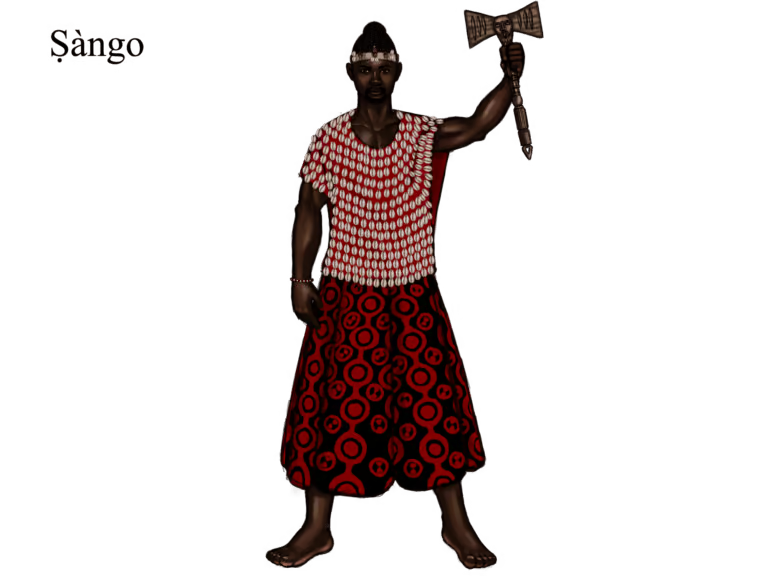
Èṣù is a trickster in the sense that, although he continually tests people’s moral resolve by placing them in moral dilemmas, he is also regarded as the Universal Policeman who punishes those who choose the immoral path. The Yorùbá therefore have a love-hate relationship with Èṣù: as the Universal Policeman, he is the pillar of truth and justice; as a trickster, he tempts and entraps. It was this strategy of describing a foreign religion in pre-established indigenous conceptual schemes that led to the remarkable success of Africa’s first Bishop.7
Yorùbá Religion: A Sophisticated Foil
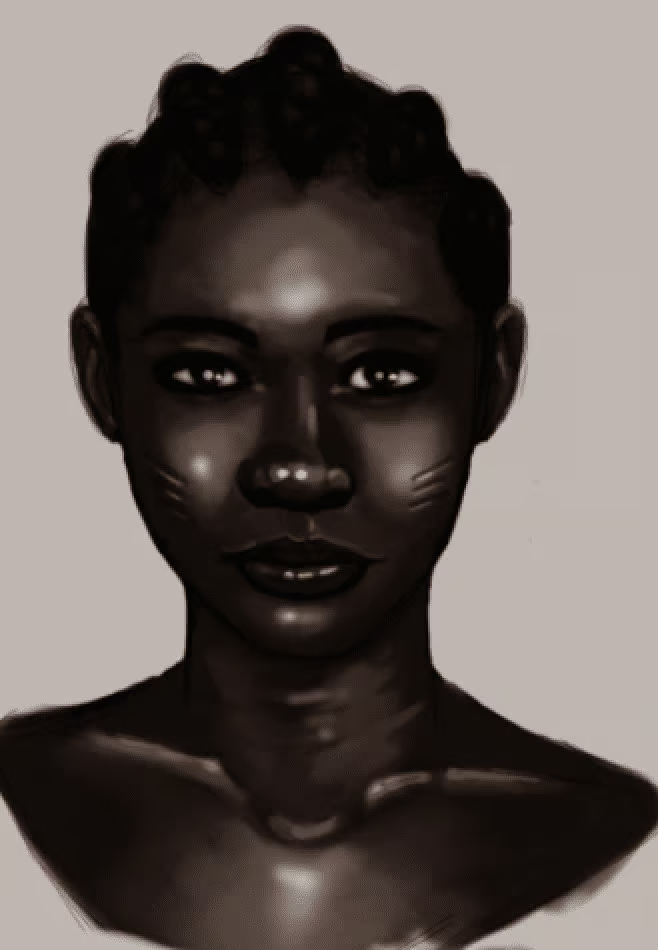
Yorùbá Religion is one of the largest indigenous religions in the world. Prior to colonialism, the Yorùbá World spanned southwestern Nigeria, the middle to southern parts of Bénin Republic, the middle of Togo, and roughly two hundred villages in present-day Ghana. Due to historical accidents, the Yorùbá were among the last Africans captured as slaves.
The Old Ọyọ Empire—then a major West African power—collapsed just before abolition, making Yorùbáland a free-for-all area for slave raiders. Another significant factor was the sophistication of Yorùbá Religion itself. Despite being an oral culture, Yorùbá society was deeply educated, founded upon Ifá as the basis of knowledge and learning. Many indigenous Yorùbá did not find Christianity appealing—after all, if it is not broken, why fix it?
In contemporary terms, there are close to ninety million practitioners of Yorùbá Religion worldwide.8 But many would also be classified as Christians, because their religious worldviews—icons, rituals, and theologies—are both Yorùbá and Christian.
Syncretism in the Americas
Consider Brazil. Yorùbá Religion has various denominations there—Candomblé, Santería, Macumba, and Umbanda.9 The same believer who practises Catholicism on Sunday may practise Candomblé on Monday. The cross, or more appropriately the crossroads, is one of the most important icons of Yorùbá Religion. It represents Èṣù, who poses moral dilemmas at significant turning points, and it is the sign of the ancestors.
What many African churches have done is take Crowther’s evangelical methodology to its logical conclusion. The worldview of many African and Latin American churches now includes indigenous supernatural entities—Èṣù, the Ajọ́gun (evil supernatural forces), the Ajẹ́ (improperly translated as “witches”), and the Abíkú (children “born to die”). Some rituals performed in African churches are borrowed directly from indigenous religions.
A Revolution Bolder Than the First
The sixteenth-century Reformation ended the ecclesiastical supremacy of the Pope and established the Protestant churches. Christendom is now undergoing another Reformation—arguably bolder and more cataclysmic. Not only is the centre of gravity moving from the rich North to the poor South, but Christianity, a religion that has for two millennia been monotheistic, is now being repackaged to incorporate many aspects of polytheistic indigenous religions.
Preserving the Living Tradition: The Òrìṣà Spiritual Assembly
The dynamics described in this essay raise a critical question: what happens to the original tradition as its concepts are absorbed and reinterpreted by another faith? If Èṣù becomes Satan and Olódùmarè becomes the Christian God, the theological nuance of the original Yorùbá understanding risks being flattened or lost entirely.
It is precisely this concern that animates the work of the Òrìṣà Spiritual Assembly (orisa.org), a sacred community founded in 2014 in Chicago when practitioners of Òrìṣà Ìṣẹ̀ṣẹ and Brazilian Candomblé gathered for sunrise prayers at the Osaka Gardens. The Assembly preserves and teaches the Òrìṣà tradition on its own terms—not as raw material for Christian domestication, but as a complete spiritual path.
Through its affiliated Ifá University (ifa.university), the Assembly offers courses, rituals, and mentorship built around Ìwàpẹ̀lẹ́—”good and gentle character”—the ethical heart of Òrìṣà practice. The Logunleko Ifá Archives present all 256 Odù of Ifá in multimedia formats, documenting the scriptural tradition of Yorùbá Religion with scholarly rigour.
Where Christian domestication has reduced Èṣù to a one-dimensional devil, the Assembly restores his full complexity as both trickster and moral enforcer. Where syncretic practice blurs the boundary between Òrìṣà devotion and Christian worship, the Assembly provides a space for practitioners to engage with Òrìṣà spirituality in its undiluted form—through divination, initiation, ancestral veneration, and the cultivation of Orí Inú.
The New Reformation is not simply a story of Christianity absorbing African spirituality. It is equally a story of African spirituality asserting its own vitality, coherence, and global reach. Institutions like the Òrìṣà Spiritual Assembly represent the other side of this transformation: ensuring that as Yorùbá concepts travel the world, the tradition that gave birth to them continues to thrive as a living, self-renewing faith.