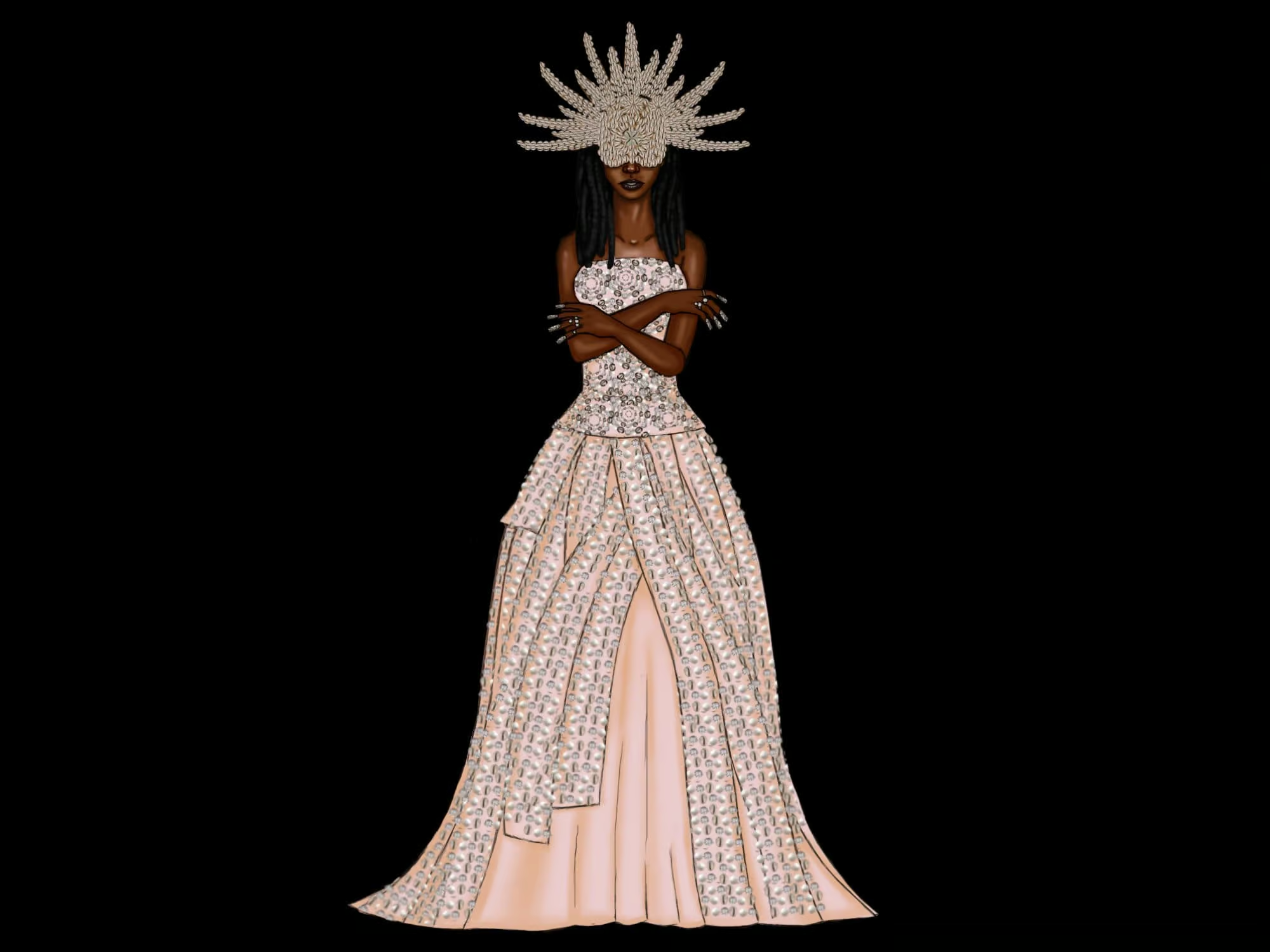
A Yorùbá bead is a syllable. To say that is not poetic licence. The vocabulary of Yorùbá beadwork — the colours, the geometries, the placement on body and shrine and crown — constitutes a system of meaning that operates parallel to the spoken language and that, in certain contexts, replaces it. To wear the wrong colour to a Ṣàngó shrine is to commit a kind of grammatical error. To beadwork the name of an Òrìṣà onto a sash, as the Ọbalúayé piece on this page does, is not decoration. It is invocation.
This is the briefest possible introduction to a vocabulary that takes years to learn. It is offered here for two kinds of reader — the curious newcomer who wants to know what they are looking at, and the practitioner who already wears the beads and would like to see, for once, the system written down.
## The Colours
The Òrìṣà have colours. Each deity is signed in the visual field by a chromatic vocabulary that is, with very few regional variations, stable across Yorùbáland and the diaspora. To enumerate the most important:
Ọbatálá is white. This is unconditional. The cloth, the beads, the food offered, the chalk used to mark the body of the initiate — all white. The whiteness is not absence of colour; it is fullness. Ọbatálá is the deity of clarity, of moral coolness, of the unblemished consciousness that makes ethical life possible.
Ṣàngó is red and white. Red for the lightning, white for the cool of the cloud that bears it. The double-headed thunderaxe (òṣẹ́) that signs his presence is, in beaded versions, almost always worked in red and white seed beads.
Ọya is wine, dark red, sometimes purple-black. The wind-coloured Òrìṣà of the Niger; the colour of leaves in the moment before the storm.
Ògún is green and black. The deity of iron, of the blacksmith and the soldier and (now) of the surgeon and the truck driver. The green is the bush; the black is the iron itself.
Ọ̀ṣun is yellow, gold, sometimes amber. The colour of the river bed in afternoon light, the colour of brass.
Yemọja is blue and white, occasionally with crystal. The waters of the Ògùn river in West Africa, the salt waters of the bay in Brazil.
Èṣù is red and black. The keeper of the crossroads; the colour of fire and of darkness, the dual axis of his keeping.
Ọbalúayé is red, sometimes with white, often with cowries. The deity of the earth, of healing through the body, of the diseases that the earth both bears and cures.

## Coral, Cowries, and the Materials of Authority
The materials matter as much as the colours. Coral (ìyùn) — Mediterranean in origin, traded across the Sahara to Yorùbáland for at least eight hundred years before European contact — is the material of chiefly authority. The Ọba of any major Yorùbá town wears coral; so does the senior priestess at any major shrine. Coral signifies the convergence of political and spiritual authority that is, in Yorùbá theory, supposed to characterise legitimate rule.
Cowrie shells (owó eyo) are simultaneously money, ornament, and ritual material. They were the currency of the Bight of Benin from at least the fourteenth century until the British colonial administration replaced them in the late nineteenth. A beaded container that is also encrusted with cowries — like the one on this page — is making a particular claim: that what is inside is at once economically valuable and spiritually charged, and that the two valuations cannot be cleanly separated.

Glass seed beads — the small uniform beads from which most Yorùbá beadwork is made — are a more recent introduction, dating to the Atlantic trade. The technique itself is old; the materials of the technique have evolved. Most contemporary Yorùbá beadwork, including the Ọbalúayé piece on the cover of this article, uses Czech glass seed beads sourced through Lagos markets.
## Reading a Crown
The classical demonstration of beadwork as language is the Yorùbá beaded crown (adé). A crown of an Ọba is not a hat. It is an architecture. The veil of beads that descends from the crown to obscure the king’s face when he is wearing it (the *ìbòrí* veil) is itself a cosmological statement: the Ọba’s face, while he is acting in his ceremonial capacity, is not the face of the man but the face of the office. The veil mediates the substitution.
The faces worked into the body of the crown — usually four — represent the deified ancestors and the protective Òrìṣà of the lineage. The bird that almost always surmounts the crown represents Òdùdúwà and the *àjẹ́* (the spiritual power of the senior women whose blessing legitimates rule). To wear the crown without the bird is to wear an object that has not been activated.
Henry Drewal’s foundational work on Yorùbá beadwork — particularly the long collaboration with John Mason at the Indianapolis Museum — remains the best entry into this material in English.1 What that work establishes, beyond reasonable dispute, is that the crown is not symbolic of authority. It *is* authority. To handle it is to engage with the political and spiritual architecture it constitutes.
## Reading the Body
The body itself is also a beadworked surface. The initiate of any major Òrìṣà receives, at initiation, a set of beads to wear at the wrist or neck — single-strand, in the colour of the deity, often with specific patterns of doubled or alternating colours that encode further information about the initiate’s particular place within the community of devotees.
These beads are not jewellery. They are not removed for sleep or shower. To break a strand of consecrated beads is a serious matter and requires ritual remediation. The beads are, in the strict sense, an extension of the wearer’s *orí* — the inner head, the personal destiny — into the visible world.
This is why, when a Yorùbá practitioner sees another wearing beads of a particular colour and pattern, an entire conversation has already happened before the first word. The visible vocabulary has done its work.
## The Beadwork Workshops Today
The renaissance has been kind to the beadwork workshops of Òṣogbo, Ìbàdàn, and (especially) Lagos. There are perhaps a hundred and fifty serious workshops in southwestern Nigeria today — a number that, while difficult to verify precisely, has grown substantially in the last decade as diaspora demand has expanded the market.2
The workshops range from individual artisans working from family compounds to small studios employing five to twelve beaders. Most of the senior practitioners are women; most of the apprentices learning the craft now are also women. The work is patient and exact: a single ceremonial sash may take three to four weeks of full-time work to complete. A beaded crown may take a year.
The materials, the techniques, the lineage of who taught whom — all of it survives. The beads continue to speak.