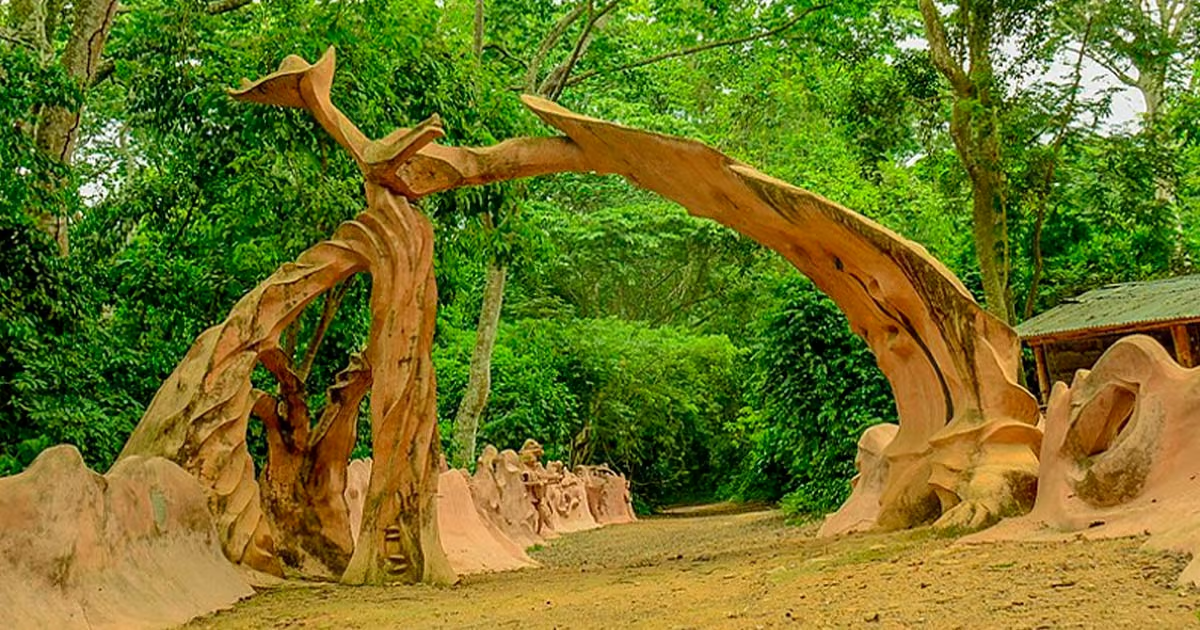
The grove is older than the city. This is the first thing one needs to understand about Òṣogbo.
The town of Òṣogbo, in present-day Ọ̀sun State in southwestern Nigeria, was founded — according to the foundation legend that every Òṣogbo schoolchild can recite — when the wood-cutter Lárọ̀ọ́yè felled a tree that landed in the river, and a voice from the river demanded that the town make peace with its waters before any settlement could stand. The voice was Ọ̀ṣun’s. The peace was made. The town was founded on the riverbank, with the express understanding that the forest along the river belonged to the deity and could not be cleared.
That covenant has, with extraordinary improbability, been kept for between four and five hundred years. The Ọ̀ṣun Sacred Grove — seventy-five hectares of mature gallery forest along the Ọ̀ṣun river, immediately adjacent to a city of half a million people, in a region where forest cover has been catastrophically reduced over the last century — is one of the very few places in West Africa where the original lowland rainforest still stands.
In 2005, UNESCO inscribed the Sacred Grove as a World Heritage Site, citing both its ecological significance and the fact that it remains a living place of worship rather than a monument. The inscription was the formal international recognition of what the people of Òṣogbo had always known: that the grove was a sacred fact, not a museum.
## The Festival and Its Calendar
The annual Ọ̀ṣun-Òṣogbo Festival takes place each August, beginning with the *Iwopopo* (the cleansing of the town) and culminating two weeks later with the *Ìbọrí Adé* (the cleaning of the royal crowns) and the procession of the *Arugbá* — the young virgin who carries the calabash of offerings from the palace to the grove.
The Arugbá is the central figure of the festival. She is selected from a designated lineage of the royal family; her selection is announced in advance; her preparation involves weeks of seclusion, prayer, and fasting. On the day of the procession, dressed in white, she walks the route from the palace to the riverside shrine carrying the covered calabash on her head. Tradition holds that if the calabash is dropped, or if the Arugbá looks back, the year ahead will be cursed; if the procession completes successfully, the year will bring prosperity.
The procession itself is the spectacle. The Arugbá walks in front; behind her come the senior priestesses of Ọ̀ṣun (the *aworo*); behind them, the king and his chiefs; behind them, the Babaláwo and the priests of the other Òrìṣà; behind them, the entire town and the visitors who have travelled in from across Nigeria, the diaspora, and the world. By the time the procession reaches the river, the route is lined ten and twenty deep with celebrants.
## What the Numbers Look Like
The Òṣogbo state government’s official estimate for festival attendance has crossed one million in recent years; the lower-bound serious estimate is half a million. The visitor mix is striking: roughly half are domestic Nigerian visitors, mostly from southwestern Nigeria; the remainder are split between international visitors from the African diaspora (Brazilian, Cuban, North American, increasingly British and continental European) and a smaller but growing tourist contingent attending principally for the spectacle and the cultural significance.
The economic impact on Òṣogbo is substantial — the city’s hotels, restaurants, and craft markets do something on the order of a year’s normal business in the festival fortnight — and the soft-power impact on Yorùbá identity is, arguably, more substantial still. For many in the diaspora, the Òṣogbo festival is the one annual moment when the entire global Òrìṣà family is visibly present in one place.
## Susanne Wenger and the Restoration
The grove as it now stands owes its preservation, in significant part, to the work of Susanne Wenger (1915–2009) — an Austrian-born artist who arrived in Nigeria in 1950, became a priestess of Ọbatálá and later of Ọ̀ṣun, and devoted the second half of her life to the restoration and protection of the grove and its shrines.
Wenger’s work at the grove combined three distinct activities. She organised, with the Òṣogbo *Ìyá Ọ̀ṣun* and her allies, the legal and political defence of the grove against successive efforts to clear it for farmland or development. She commissioned and supervised the construction of a remarkable series of sculptural shrine structures — large concrete-and-iron works in a style that drew on traditional Yorùbá visual vocabulary while being unmistakably twentieth-century in execution — that gave the grove a contemporary architectural presence. And she trained a generation of Òṣogbo artists, sculptors, and dyers who carried both the traditional skills and Wenger’s own innovations into independent practice.1
Her position in the history of the grove is complex and not without controversy. She was a foreigner who became a senior priestess; she introduced new aesthetic forms to a setting that was already aesthetically complete; she wielded considerable political authority in the defence of the grove. The judgment of the senior Òṣogbo priesthood, broadly, is that her contribution was indispensable. The grove that received UNESCO inscription in 2005 was the grove that her work, in collaboration with the Òṣogbo lineage, had made visible to the world.
## How to Attend
For practitioners and serious visitors, the most useful guidance is to arrive in Òṣogbo at least three days before the procession of the Arugbá. The smaller events of the preceding two weeks — the cleansing of the town, the lighting of the Atúpà Olójúmẹ́rìndínlógún (the sixteen-point lamp), the visits to the river shrine by the senior priesthood — are accessible to outsiders with appropriate introduction and offer a depth of experience that the procession day, by virtue of its sheer scale, does not.
Accommodation in Òṣogbo books out months in advance. The Heritage Hotel and the smaller guesthouses near the palace fill first; many visitors stay in nearby Ìlọrá or Ìkirun and travel in. Local transport on the procession day is essentially impossible; plan to be near the palace by sunrise or to walk.
The grove itself is open to respectful visitors year-round, not only during the festival. A guided visit through the smaller shrines along the river, in the off-season, is a different and arguably more contemplative experience than the festival itself. Both are worth doing.
The river runs. The grove stands. The covenant continues.