Western academic philosophy has, in the last twenty-five years, undergone a quiet but consequential revision in its understanding of what counts as a philosophical tradition. The opening of the canon to the substantive engagement with Indian, Chinese, Arabic-language Islamic, and African philosophical traditions has been uneven and is far from complete, but the direction of travel is established. The question is no longer whether non-Western traditions are *philosophical* in the sense the discipline cares about. The question is what those traditions, taken seriously on their own terms, have to teach the discipline.
This article is a brief argument for one specific contribution: that the Ifá corpus — the 256 Odù of the West African Yorùbá divinatory and philosophical system — constitutes a complete and rigorous epistemological framework that addresses problems Western philosophy has struggled with for centuries, and addresses them in ways that the discipline would benefit from confronting.
I write this as both an academic philosopher (my doctoral training was at the Department of Logic and Scientific Method at the London School of Economics in the 1990s; my appointment is at Howard University) and as a Babaláwo (initiated by my father Wándé Abímbọ́lá in 2014, in a lineage that runs through his teachers in Ọ̀yọ́ and Ìbàdàn). The double position is unusual but not unique; it is becoming less unusual each year.
## What Ifá Is, in Brief
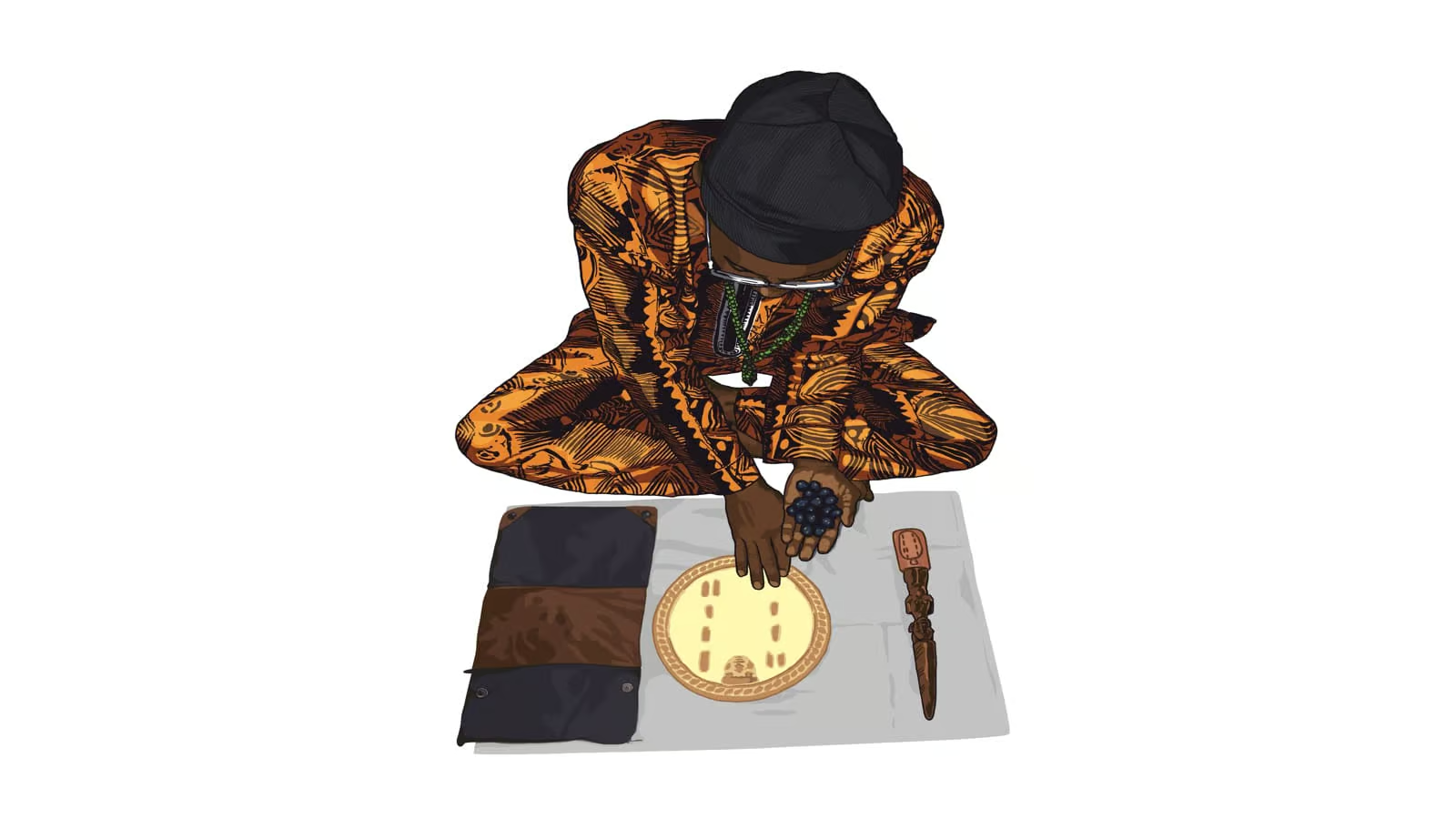
For the reader unfamiliar with the structure of Ifá: the system is organised around 256 *Odù*, each of which is identified by a specific configuration of marks on the divination tray (or, equivalently, a specific result from the casting of the *ọ̀pẹ̀lẹ̀* divining chain). The 256 Odù decompose into 16 *Odù Méjì* (the major or “twice” Odù) and 240 minor combinations.
To each Odù is attached a body of *ẹsẹ* — verses — that constitute the substantive content of the system. The verses are narrative in form: each tells the story of a particular figure (sometimes an Òrìṣà, sometimes a historical or legendary king, sometimes an ordinary person) who consulted Ifá about a particular problem, what Ifá prescribed by way of *ẹbọ* (ritual offering or sacrifice), and what consequences followed from the figure’s compliance or non-compliance with the prescription.
The standard estimate is that the corpus contains, across all Odù, somewhere on the order of four to six hundred *ẹsẹ* per Odù; the total corpus accordingly runs to something on the order of one hundred thousand verses, though no single Babaláwo holds the full corpus and the boundaries of what counts as canonical versus regional variation are themselves a live scholarly question. Wándé Abímbọ́lá’s *Sixteen Great Poems of Ifá* (1975) made the *Odù Méjì* substantively available to scholarship for the first time; the full corpus remains a long-term project.1
In ritual practice, when a Babaláwo divines for a client, the casting determines which Odù governs the consultation. The Babaláwo then recites the relevant *ẹsẹ* — selecting from memory those verses whose narrative most closely matches the client’s situation — and prescribes the corresponding *ẹbọ*.
## Why This Is a Philosophical System
The temptation, for the academic philosopher encountering this structure for the first time, is to read Ifá as a religious system that includes some philosophical *content* but is not itself philosophy. This reading is mistaken. Ifá is philosophical in three respects that I want to specify carefully.
First, the corpus is *organised around the systematic treatment of recurring problem-types*. The narratives of the *ẹsẹ* are not random anecdotes; they are exemplars of particular kinds of human and cosmic situations — choice under uncertainty, conflict between obligations, the relationship between individual aspiration and collective good, the management of risk, the conditions for appropriate action when knowledge is incomplete. The 256 Odù, taken together, constitute a typology of such situations sufficiently complete that any actual case can be referred to a particular Odù as its proper home.
Second, the corpus operates with *explicit normative criteria* for evaluating action. The recurring evaluative vocabulary — *ìwà* (character), *orí* (the inner head, individual destiny), *ọ̀pẹ̀* (gratitude/appropriateness), *àṣẹ* (efficacious authority) — constitutes a worked-out ethical and metaphysical scheme that is no less elaborate than the corresponding Aristotelian or Confucian schemes.
Third, the corpus *self-reflects on its own epistemological conditions*. The verses of certain Odù are explicitly about the conditions under which Ifá itself can be consulted reliably, the limits of divinatory knowledge, the role of the consulting client’s own honesty in the success of the process, and the relationship between what Ifá reveals and what the client must work out for themselves. This is, in the strictest disciplinary sense, *epistemology*.
## The Specific Epistemological Contribution
Western epistemology in the analytic tradition has, since at least Edmund Gettier’s 1963 paper, struggled with the question of what makes a particular instance of belief count as *knowledge*. The post-Gettier literature has produced a vast taxonomy of conditions — internalist and externalist, reliabilist and virtue-theoretic, contextualist and invariantist — none of which has commanded general assent within the discipline.
Ifá’s contribution to this discussion can be stated, somewhat compressed, as follows. The Ifá conception of knowledge does not begin with *belief* as the primary unit, as the post-Gettier literature does. It begins with *appropriate response to situation* as the primary unit, and treats belief as a derivative — useful insofar as it conduces to appropriate response, of secondary interest where it does not. The criterion for whether a Babaláwo’s reading of an Odù is correct is not whether the propositional content of the reading corresponds to some external state of affairs (the correspondence-theoretic criterion that dominates Western analytic epistemology). The criterion is whether the prescribed *ẹbọ*, undertaken by the client, produces the situational change the client requires.
This is, in Western philosophical terms, a *pragmatist* epistemology — but a pragmatist epistemology of a particular sort, one that does not collapse into the relativism that pragmatism in its Western forms has often been accused of. The constraint on what counts as appropriate response is not whatever-works-for-the-individual; it is constrained by the entire structure of the corpus, by the verses that the Odù makes relevant, by the *ìwà* requirements that the verses specify, and by the system of mutual accountability among Babaláwos that ensures that idiosyncratic readings are subject to peer correction.
The result is a system that is rigorous (the Babaláwo can be wrong, and his community of peers will identify when he is), responsive to situation (the same Odù casts differently for different clients precisely because the application of the verses to the case is interpretive work), and grounded in normative criteria that are not reducible to individual preference (the *ìwà* requirements are public, debatable, and binding in the way that Western ethical theories struggle to ground their own normative claims).
## What Else Western Philosophy Could Learn
Three further contributions of the Ifá tradition to questions Western philosophy has not handled well:
The Ifá conception of *personhood*, organised around the *orí* (the inner head, the individual destiny chosen before birth) in dynamic relationship with *ìwà* (character, what one makes of one’s destiny through life-action), provides a substantive account of the relationship between the given and the achieved in personhood that Western philosophy of self has struggled to articulate. The *orí* is given; *ìwà* is the work of the lifetime; and the Yorùbá insight is that neither alone constitutes the person — it is the active relationship between them, mediated by appropriate ritual action and by ongoing community accountability, that makes personhood possible.
The Ifá conception of *time*, which combines a strong account of ancestral presence (the dead remain consequentially present in the world of the living, and ritual maintains the relationship) with a structurally future-oriented practice (every divination prescribes action whose effects will manifest in time), avoids both the pure presentism of much contemporary analytic metaphysics and the pure historicism of much continental philosophy. The Yorùbá insight is that time is *populated* — by ancestors behind, by destiny ahead, by the present configuration of relationships in the middle — and that the appropriate response to populated time is ritual maintenance of the relationships across all three.
The Ifá conception of *truth* — the *ìṣẹ́* of the *aṣírí* (the work of the secret, the ongoing project of bringing what is hidden into appropriate relation with what is manifest) — offers a model of truth as relational practice rather than as static correspondence, in ways that anticipate and to some extent surpass the recent Western interest in process and pragmatist accounts.
## Why the Conversation Now
The conversation between Western philosophy and Ifá is happening now, in 2026, for several specific reasons.
The texts have become available. The publication of Wándé Abímbọ́lá’s foundational works between 1968 and the present has put serious primary material into international scholarly circulation; the work of Sophie Olúwọlé, Olúfẹ́mi Táíwò, the late Henry Olélá, and others has put serious philosophical interpretation into the international literature.2
The personnel are in place. The generation of philosophically trained scholars who are also initiated practitioners — the position I occupy, which my father Wándé Abímbọ́lá held before me, which is now held by others — is for the first time large enough that the internal conversation has a critical mass.
The discipline of Western philosophy is, finally, prepared to listen. The opening to non-Western traditions that began in earnest in the 1990s with the rise of comparative philosophy has now matured to the point that work from the Yorùbá tradition is being taken seriously at major departments and in major journals.
What remains is the substantive work of the engagement. The Ifá corpus is large, dense, and not reducible to a handful of theses that can be summarised in an abstract. The work of bringing it into productive conversation with Western epistemology, ethics, philosophy of mind, and metaphysics is the work of the next generation. This article is a small contribution to the conversation. The work continues.
The 256 Odù are a complete philosophical system. They have been one for a thousand years. The question is whether the wider discipline will engage them as such.
I think it will. I think it must. And I think the engagement will change Western philosophy — not by replacing it, but by expanding what it understands itself to be.