On a Saturday morning in March 2026, three things happened within six hours of each other. In Salvador, Bahia, more than four thousand people walked the procession to the bay for a Yemọja festival that began before sunrise. In Brooklyn, a botánica that opened in 1971 closed for the day so its proprietor — now in her eighties — could initiate her granddaughter as a priestess of Ọbatálá. And in Òṣogbo, the artisans who guard the Sacred Grove began the long work of preparing for August, when between half a million and a million pilgrims will pass through the gates that Susanne Wenger first restored in the 1950s.1
These are not curiosities. They are signs of something that has been gathering quietly for decades and has, in the last ten years, become impossible to ignore: a global renaissance of Òrìṣà worship that is at once a return and a transformation.
To understand the renaissance, it helps to begin where most accounts begin: with what was almost lost. In the late nineteenth century, colonial administrators and missionaries — Yorùbá and European alike — described the indigenous tradition as a thing in retreat. Conversion to Christianity and Islam was reshaping public religion across the Bight of Benin. By the middle of the twentieth century, Yorùbá scholars themselves were writing about the tradition in the past tense, even as it persisted in family compounds and at the back of every market.
What the colonial frame did not see — could not see — was the second life that the tradition had already begun, and would continue, on the other side of the Atlantic.
## The Atlantic Crossing as a Religious Fact
The Yorùbá-derived religions of the Americas — Lukumí in Cuba, Candomblé in Brazil, Vodou in Haiti, the various Òrìṣà houses of Trinidad and the Carolinas — are not simply West African religion exported. They are West African religion that survived a catastrophe by changing, and that changed without ceasing to be itself.
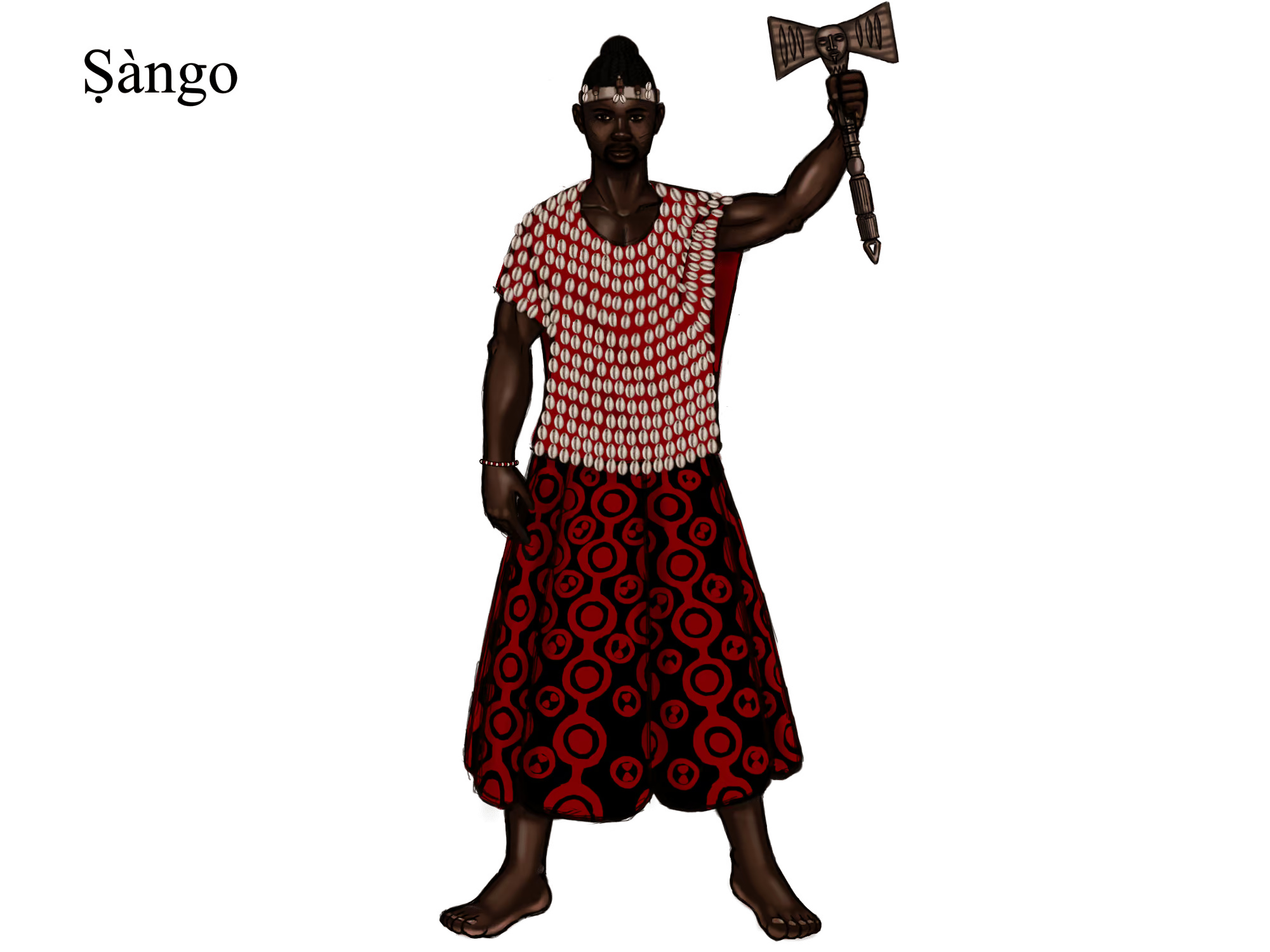
The mechanism mattered. When enslaved Yorùbá-speaking peoples arrived in the New World, the colonial regime forbade their worship. The response was syncretism — not the loss of the deities but the protective overlay of saints, the silent identification of Ṣàngó with Saint Barbara in Cuba, of Ọbatálá with the Virgin of Mercy, of Èṣù with the Holy Child of Atocha. The saints were a passport. The Òrìṣà travelled inside them.
What this meant, in 2026 terms, is that when the renaissance began, the tradition had already done what very few religious traditions in modern history have managed: it had survived more or less continuously, in unbroken oral and ritual transmission, across more than five centuries and four continents.
## The Renaissance, Properly Speaking
When did the renaissance begin? There are several plausible dates.
One can begin with 1959 — the founding of the Òyótúnjí African Village in South Carolina by Ọ̀ṣẹ́ìjímán Adéfúnmì, the first sustained effort to reconstitute a Yorùbá religious community on North American soil. One can begin with 1981, when Wándé Abímbọ́lá’s *Sixteen Great Poems of Ifá* made the textual core of the Ifá corpus available in serious scholarly form for the first time in English.2 One can begin with 2005, when UNESCO designated the Ọ̀ṣun-Òṣogbo Sacred Grove a World Heritage Site — the formal recognition by an international body that the tradition was not folklore but living patrimony.
Or one can begin where I prefer to begin: with the recognition, in many parts of Yorùbáland and the diaspora simultaneously, that the people who were practicing the tradition all along had been right, and that the question was no longer whether Ifá would survive but what shape its second flowering would take.
## What Is New, What Is Continuous
The renaissance has new features that distinguish it from any earlier moment in the tradition’s history.
The first is *literacy*. Ifá is fundamentally an oral tradition; its 256 Odù — the divinatory chapters that constitute the core of the corpus — are passed from teacher to student through years of memorisation. But the renaissance is the first moment in the tradition’s history in which a substantial fraction of practitioners can read, write, and publish in their own language about their own practice. The result is not the displacement of orality (the Babaláwo who recites for a client still does so from memory) but the addition of a textual layer that complements and extends it.
The second is *digital reach*. A Yorùbá ritual recorded in Lagos in May is watched in Salvador, Houston, and London by June. A piece of beadwork commissioned in Òṣogbo arrives in Atlanta within a week. The geography of the tradition has been compressed in a way that no earlier generation could have imagined.
The third — and most important — is *self-confidence*. The colonial-era apologetic posture, in which Yorùbá practitioners had to defend the tradition against accusations of superstition or worse, has largely been abandoned by the younger generation. The work now is not defence but elaboration: working out what the tradition has to say about questions that it has not had to address before — bioethics, climate, gender, artificial intelligence — without surrendering its own categories.
What is continuous is everything that matters most. The 256 Odù are still the 256 Odù. Èṣù is still the keeper of the crossroads. The sacrifices that the Odù prescribe are still the sacrifices a Babaláwo will perform at his shrine on a Sunday morning in Brooklyn or a Wednesday evening in Lagos. The renaissance is not a reformation in the sense of a doctrinal break. It is a renaissance in the older sense — a renewed flowering of something that did not stop growing even when it appeared to be dormant.
## The Numbers, As Best We Can Count Them
Reliable counts of practitioners are notoriously difficult. National censuses in Nigeria and Brazil under-count the tradition for political and definitional reasons; in the United States, “Òrìṣà religion” appears in survey instruments only as a residual category. The most-cited estimates — that there are roughly 100 million practitioners worldwide of religions in the Yorùbá derivative family — should be taken as a rough order of magnitude rather than a hard number.3
What is clearer is the *trajectory*. The tradition is growing fastest, in absolute terms, in three places: in southwestern Nigeria itself (where younger generations are increasingly returning to it as a primary religious identity, often in addition to a Christian or Muslim public identity); in Brazil (where Candomblé membership has been growing year over year for at least two decades despite considerable pressure from neo-Pentecostal movements); and in the United States and Canada (where Lukumí and Òrìṣà-Voodoo communities have become numerically significant in cities including New York, Miami, Houston, Atlanta, and Toronto).
## Three Renaissances, One Tradition
What is most striking — and most difficult to convey in a single article — is that the renaissance is not one event but three overlapping ones.
In Yorùbáland, the renaissance is partly a recovery: the return of practices, vocabulary, and ritual confidence that had been pushed to the margins by a century of colonial and missionary pressure. The work here is restorative.
In the Latin American diaspora — Brazil, Cuba, the wider Caribbean — the renaissance is partly a *deepening*: the existing communities are reconnecting with the West African source, traveling to Yorùbáland to undergo initiations that complement those they have already received in their home traditions, and reading widely in scholarship that for most of the twentieth century was inaccessible to them. The work here is integrative.
In North America and Europe, the renaissance is partly a *founding*: communities of practice that did not exist a generation ago are forming, holding their first festivals, training their first generation of priests and Babaláwos. The work here is constitutive.
These three renaissances are not always in agreement. There are real disputes — about authority, about gender (in particular about who may be initiated into Ifá itself, on which Yorùbá and diaspora houses sometimes differ), about how much innovation the tradition can absorb without ceasing to be itself. These disputes are signs of life. A tradition that is not arguing about itself is a tradition that is no longer growing.
## What This Journal Is For
This is the inaugural issue of *Olódùmarè: A Journal of Òrìṣà Studies*. It exists because the renaissance now needs the kind of publication it has not yet had: a serious magazine that takes the tradition on its own terms, that publishes scholarship and practice and art without flattening any of them, that speaks to the practitioner and the curious reader at once.
In the issues to come we will publish on Ifá and epistemology, on the festivals of Yemọja and Ọ̀ṣun, on the diaspora corridors and the sacred objects, on the chapter leaders and the elders and the teenagers who are inheriting all of this from us. We will publish work that is sometimes difficult and sometimes contested. We will print the disputes alongside the celebrations.
The renaissance is here. This journal is one record of it.